

Best Base in the Dolomites for Your First Trip
If this is your first trip to the Dolomites, choosing where to stay can feel oddly high-pressure. Not because there’s a wrong place to go, but because the wrong base can quietly make your whole trip harder than it needs to be.
We’ve seen this happen on our own trips and when reviewing our client itineraries. Drive times that look fine on a map turn into long, draining days. Plans fall apart when weather shifts or energy dips. And suddenly the trip feels rushed for no obvious reason.
Almost always, it comes back to one decision made early on – where you’re staying.
The Dolomites don’t have one perfect base, and that’s a good thing. What they do have are areas that work better for different kinds of trips because they keep logistics simple and give you room to adjust as you go.
We’ve explored the Dolomites in peak summer and quieter shoulder seasons, staying all over from Val Gardena, to Alta Badia, to Cortina, and more. Those trips made one thing very clear – a good base doesn’t help you see everything, but it does help your days flow.
For most first-time visitors, the choice realistically comes down to two areas – Val Gardena in the western Dolomites, or Cortina d’Ampezzo (often with nearby Dobbiaco). Both give you access to the highlights you’ll actually want to see on a first trip, they just work differently.
Now, let’s figure out which side of the Dolomites fits your trip. I’ll walk you through which one makes the most sense for your travel style, and why getting the choice of where to stay in the Dolomites right is one of the easiest ways to avoid wasted time, second-guessing, and that “we should have planned this better” feeling.
What “Best Base in the Dolomites” Actually Means for a First Trip

When people search for the best base in the Dolomites, they usually picture a place that lets them see everything.
That sounds reasonable. It’s also where a lot of first trips start to go sideways.
On a first visit, the best base isn’t the one that looks central on a map or technically shortens the distance between far-flung sights.
It’s the one that makes your days easier to plan and easier to change when something doesn’t go as expected.
Because something always changes.
Weather shifts. A hike takes longer than planned. A lake looks great, but the parking situation is a mess. Or you’re just more tired than you thought you’d be at altitude.
When your base is working against you, every small change turns into a logistics problem.
A good first-trip base does the opposite. It gives you margin.
In practice, that usually means three things.
- A tight cluster of highlights nearby
You’re not spreading yourself across the entire Dolomites. You’re staying close to places that naturally group together, so you’re not driving for hours every day. - Realistic backup options
If one plan doesn’t work, you can pivot without scrapping the whole day or adding long detours. - A gentle learning curve
You get a feel for what getting around the Dolomites actually looks like, timing, and crowds before committing to more ambitious point-to-point days.
This is why I get cautious when someone tells me they want a “central” base to see everything. In real life, that often translates to longer drives, earlier mornings, and more time managing logistics than enjoying where you are.
Your first trip isn’t about maximizing coverage. It’s about building confidence.
Once you understand how the Dolomites work on the ground, you can get more ambitious later. Starting with the right base makes that learning curve a lot smoother.
The Short Answer for first-time visitors

If you want the simplest, smoothest introduction to the Dolomites, here’s the decision for you:
- Choose Val Gardena if you want to explore the western Dolomites.
You’ll get shorter drives, a high concentration of highlights, and days that feel manageable instead of logistical. - Choose Cortina d’Ampezzo if you want to explore the eastern Dolomites.
You’ll have easy access to famous lakes, dramatic viewpoints, and scenic drives, and you won’t mind moving around more.
That’s the whole answer – you’re choosing between Val Gardena and Cortina. There’s no secret third base and no perfectly central town that does everything equally well.
Both options work – they just serve different sides of the Dolomites. When you match your base to what you actually want to see, your trip feels calmer, easier, and far more enjoyable.
For a first visit, picking the right side matters more than chasing the “perfect” town.
Once you’ve chosen the right side, the hotel decision becomes much simpler — and that’s where most first-timers accidentally overcomplicate things.
Are you afraid of making the wrong choice?
Let’s figure the correct base for you out together.
Book a one-to-one consultation and get personalised advice on where to stay, what to prioritise, and how to build a Dolomites itinerary that fits the way you like to travel.
Val Gardena: easiest first base in the Western Dolomites

If you want a base that makes your first Dolomites trip feel calm instead of complicated, Val Gardena is hard to beat.
The valley really works well because it combines a high concentration of iconic scenery with straightforward logistics – you’re not trying to force the Dolomites to fit your plan, Val Gardena does a lot of the heavy lifting for you.
Why Val Gardena Works So Well

One of Val Gardena’s biggest strengths is how straightforward it feels on a practical level.
The valley includes three main villages: Ortisei, Santa Cristina, and Selva di Val Gardena. All three give you access to the same core area, just with slightly different “vibes” and price points.
If you want to keep costs down, Santa Cristina often has good-value apartments and simpler hotels. If you want something more upscale, you’ll find luxury and spa hotels spread across all three villages, not limited to just one area.
Otherwise, everything you need is easy to reach from each of the villages:
- Accommodation is flexible
From simple apartments to full spa hotels, Val Gardena gives you real choice without forcing you into one specific town or style of stay. - Food is easy
You’ll find everything from casual meals to Michelin-starred dining, plus supermarkets that make picnic days simple and affordable. - Getting around feels intuitive
Cable cars, short drives, and well-connected roads mean you’re not spending every morning recalculating logistics.
That kind of flexibility makes a bigger difference than most people expect once you’re actually there.
Right here are some of the best options for where to stay in Val Gardena for first time visitors.
What You Can See From Val Gardena

Val Gardena works so well because it sits right in the middle of a dense cluster of western Dolomites highlights.
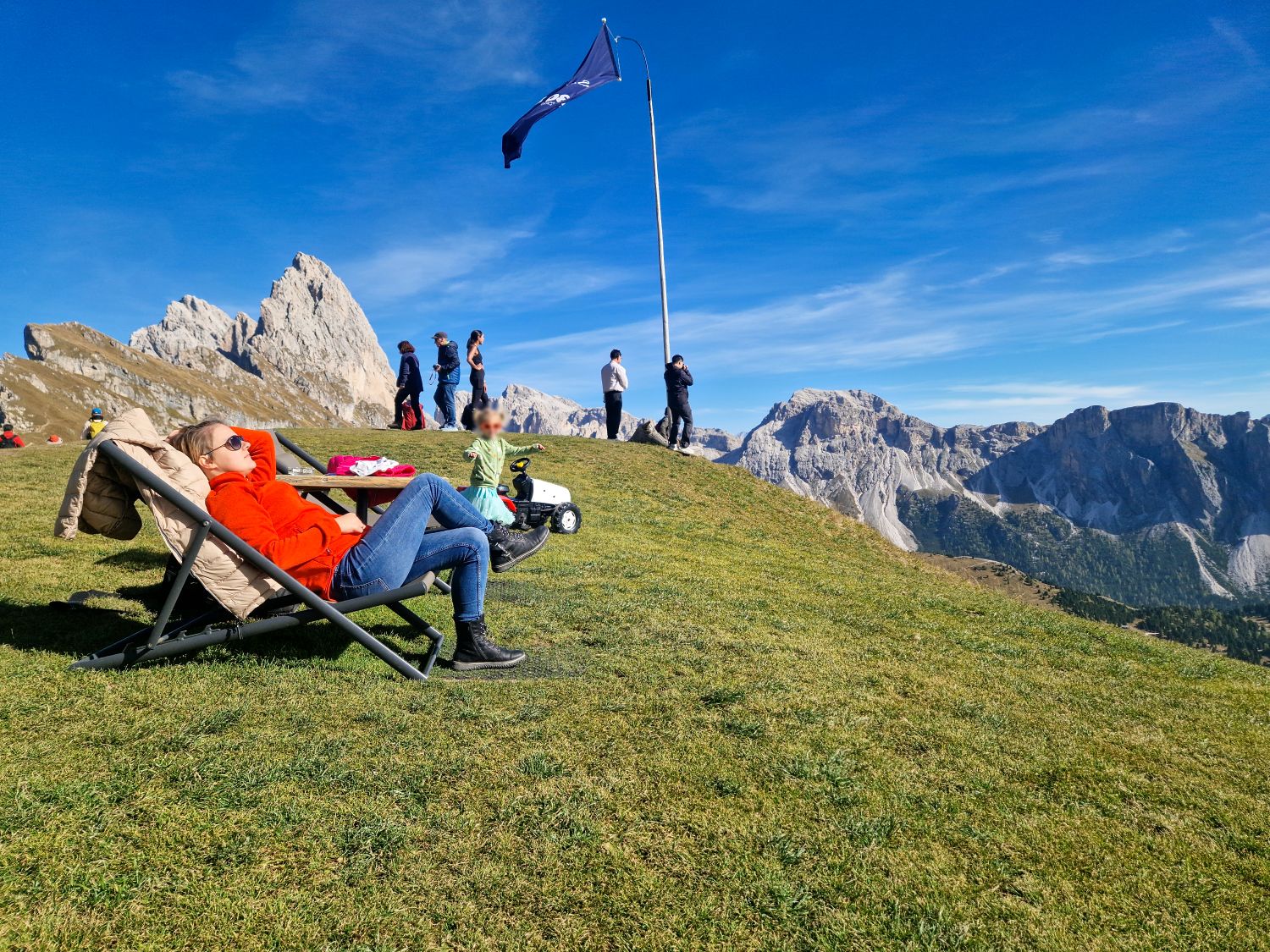
There with direct access to classic areas like Seceda, Alpe di Siusi, and Monte Pana. One of my favorite places to visit is Mont de Seura – you can see the view from there in the picture above. It’s honestly incredible.
You’re also well positioned for scenic drives over nearby mountain passes and for trips into valleys like Val di Funes and Alta Badia for a day without committing to staying there.
The key thing is consistency. You see a lot, but you come back to the same base every evening. For first-timers, that rhythm keeps the trip enjoyable instead of exhausting.
Crowd Levels, Atmosphere, and What It Really Feels Like

Let’s be honest. Val Gardena is popular. You’ll share the valley with other travelers, especially during peak summer weeks and school holidays.
But crowds in Val Gardena don’t behave the way most blogs suggest. Timing helps, of course, but where and how you move matters much more.
We stayed in Ortisei in July and still went on hikes where we barely saw anyone, even though we started around 10am. The picture is actually from that hike in the middle of July. We met crowds in the mountain hut and at the cable cars, yes, but outside of those pinch points, the valley rarely feels as overwhelming as its reputation suggests.
That’s one of the key things to understand about Val Gardena – and actually all of the Dolomites. There’s so much to do that crowds spread out instead of stacking up on one single trail all day.
Some people show up for a quick photo op at the most famous viewpoints, and others disappear for hours on longer hikes or quieter routes. Both groups exist at the same time, but they don’t move the same way.
Val Gardena Is the Right Choice If You…

- Want an easy-to-understand base that simplifies planning
- Like having a lot of choice without having to change accommodation
- Prefer balancing scenery, activities, and downtime rather than chasing everything
- Are traveling with a group that has different interests, energy levels, or priorities
If this sounds like the kind of trip you want, Val Gardena is usually the safest starting point in the Dolomites.
Once you decide that Val Gardena is the right side for your trip, the next question becomes much simpler: which village and type of hotel actually makes sense for how you travel.
- If you want walkable access and easy lifts → look into a hotel that’s close to cable cars.
- If views matter most → Here are some hotels with amazing views
- If this is a budget-conscious first trip → here are some budget-friendly options
Cortina d’Ampezzo: A Strong First Base for the Eastern Dolomites

If your idea of the Dolomites leans more toward dramatic lakes, big viewpoints, and scenic drives, Cortina d’Ampezzo in the Eastern Dolomites will be a very solid first base.
The key thing to understand upfront is this: Cortina works best as a gateway, not a hub where everything sits five minutes away. It works best if you’re comfortable moving around and prioritizing what you want to see, rather than trying to do a little bit of everything every day.
Why Cortina Works So Well for First Trips

Cortina’s biggest strength is its location.
From here, you’re well positioned to explore the eastern Dolomites: the incredible lakes, scenic drives, and big viewpoints. Roads are good, signage is clear, and the town itself is built around visitors actually coming and going, not just staying put.
Accommodation is where your expectations need to be double-checked.
Staying right in Cortina tends to be on the expensive side, especially in peak season, unless you’re okay with simpler hotels. If you’re open to staying outside town, places like Dobbiaco or San Vito di Cadore can make the same itinerary work at a lower cost, with very similar access.
We’ve stayed in both Dobbiaco and Cortina, and they can both work wonderfully. Really, you will need to drive places either way, so being flexible is definitely a good thing.
That flexibility is what makes Cortina workable for different travel styles, as long as you plan with your eyes open.
If you feel like this is the option for you, the next thing is to figure out if you stay in Cortina itself or in one of the villages nearby.
What Cortina Is Best At

This is where Cortina really shines.
From this side of the Dolomites, you can build days around places like Lago di Braies, Lago di Sorapis, Tre Cime di Lavaredo, and Cadini di Misurina without forcing long detours or awkward backtracking. Many of the highlights here work well as half-day outings, which makes it easier to pace your trip.
This is also a great base if you enjoy scenic driving with short stops. Some of my favorite places to visit on the Eastern side offer the “you don’t need to spend hours here unless you want to” options. For example, instead of hiking at Cinque Torri or Rifugio Lagazuoi, just take the cable cars up to enjoy the views or explore for an hour.
What Cortina doesn’t do as well is density. You’ll cover more ground, spend more time in the car, and switch locations more often than you would from Val Gardena.
For the right traveler, that variety feels exciting. For others, it can feel tiring.
Crowd Levels, Prices, and Trade-Offs

Cortina d’Ampezzo is famous, and it knows it. You’ll feel that fame in prices first, especially for hotels and dining, and you’ll feel it again at the most iconic spots during peak season.
If you feel like Cortina itself is too expensive, though, there are some budget-friendly bases near it that still are completely fine, like Dobbiaco.
Crowds in the eastern Dolomites tend to stack up at specific places rather than spreading out evenly.
Lakes like Lago di Braies and viewpoints with easy access (Tre Cime di Lavaredo, Rifugio Lagazuoi) draw a lot of people, often at the same times of day. Timing matters more in the eastern Dolomites because many visitors follow similar routes and schedules.
That doesn’t mean Cortina itself feels chaotic all the time. The town usually feels reasonably calm and functional, even during high season. Most of the crowds show up when you head out to the headline sights, not when you’re walking around town.
The bigger trade-off comes down to movement, though. From Cortina, you’ll almost certainly drive more between highlights than you would from Val Gardena.
And, it since Cortina is rather touristy, I don’t recommend it for the off-seasons – go for Dobbiaco instead.
So yes, you’ll benefit from a car on this side of the Dolomites.
If you go in knowing that movement is part of the deal, Cortina feels dynamic rather than frustrating.
Cortina Is the Right Choice If You…

- Care most about lakes, viewpoints, and classic eastern Dolomites scenery
- Don’t mind driving between highlights
- Are okay with higher prices or plan to stay just outside town
- Prefer variety in scenery over staying rooted in one compact area
Cortina isn’t the easiest base in the Dolomites, but for the right first-time trip, it can be a very rewarding one.
Once you know you’re leaning toward the eastern Dolomites, the next decision becomes practical rather than overwhelming: whether it makes more sense to stay in Cortina itself or base nearby and drive in.
If you’re still comfortable after reading this, here are some hotel options:
- Best places to stay in Cortina → if it’s all about convenience
- If views matter most → Here are some hotels with amazing views
- If this is a budget-conscious first trip → here are some budget-friendly options
Val Gardena vs Cortina – The Real Difference

If you’re deciding between the two, this is what it really comes down to:
- Val Gardena
Fewer drive hours, more consistency, easier pacing, lower planning stress. - Cortina
More movement, bigger variety, iconic stops, higher payoff, but with more effort.
Neither is better in general. One will simply fit your first trip better.
Travel Planning services
Ready to choose your base?
If you’re feeling overwhelmed by routes, logistics, or where to even start, you don’t have to figure it out alone. My Dolomites travel planning services turn ideas into clear, realistic itineraries built around how you like to travel.
From scenic drives to hikes, villages, and hotels, I’ll help you plan a trip that feels exciting, doable, and stress-free.
Let’s plan your Dolomites itinerary and get you one step closer to going.
One Base or Two? What Actually Works

This is quite a common planning question for the Dolomites, and it’s where a lot of first trips can get overcomplicated.
The simple rule is this:
Up to 4 nights – one base.
Full stop.
If you have less than 4 nights, changing accommodation almost always creates more stress than value. You lose usable time checking in and out, add transition days, and spend mental energy on unnecessary logistics instead of enjoying where you are.
So for shorter trips, I recommend that you choose one base that won’t force unnecessary repacking.
Why One Base Works Best for Short Trips

On a shorter trip, one base keeps things grounded.
You only need to unpack once. You learn how long mornings really take and adjust for it. You get a feel for parking, grocery stops, cable cars, and drive times without resetting halfway through the trip.
When weather shifts or energy dips, you know how to adjust the plan instead of needing to rethink the whole itinerary. That flexibility is what keeps short trips enjoyable.
With 2-4 nights, one base isn’t just easier. It almost always gives the better experience.
When Two Bases Make Sense

Two bases only start to make sense when you have more time to work with. And if you choose it intentionally instead of FOMO.
Splitting your trip usually makes sense if:
- You have a longer stay (5-6 nights or more)
- You’re clearly dividing your time between the western and eastern Dolomites or some other area
- You’re comfortable with packing up and moving mid-trip
Even then, two bases work best when each one gets enough time to settle in. One-night stopovers usually create more friction than payoff. Make sure you spend at least two nights in one area – that way, you get one whole day to explore.
The Rule to Remember

I just want to reiterate it once more, because it’s just so important.
Up to 4 nights – one base
More time – consider two, but only if you know why
The most common mistake we see is trying to “run through” the Dolomites.
One base for a couple of nights, then another, and another, with a scenic transfer days in-between that look great on paper but in the end are way more tiring than enjoyable.
On a first trip, especially a short one, that approach will just lead to disappointment.
Visiting the Dolomites Without a Car – What to Expect

You absolutely can visit the Dolomites without a car. But whether it feels easy or frustrating depends entirely on where you base yourself and what kind of trip you’re expecting.
This isn’t a place where “no car” works the same way it does in cities or even other parts of Italy. Public transport exists, but it requires a lot of planning and adjustments.
Where No Car Works Best

If you’re visiting without a car, Val Gardena is usually the easiest place to start.
The valley has:
- frequent buses between villages
- good connections to cable cars
- walkable town centers
- clear, tourist-friendly infrastructure
Staying in or near Ortisei makes things especially straightforward. You can have full sightseeing days by only using lifts and by simply walking to viewpoints. Seceda, Alpe di Siusi, Rasciesa, St. James Church (Chiesa di San Giacomo / Dlieja da Sacun) can all be reached from Ortisei.
If your goal is to enjoy scenery, gentle hikes, and alpine views without constantly checking schedules, Val Gardena gives you the best chance of that happening.
Where No Car Gets Tricky

Going car-free is harder in the eastern Dolomites.
Basing yourself in Cortina d’Ampezzo without a car limits you more than most people expect. Buses exist, but they’re less frequent or routes don’t always line up cleanly.
You can still make it work, but your days will revolve around schedules instead of weather, energy, or mood. That trade-off matters on a first trip.
If you want to explore the Eastern Dolomites without a car, Dobbiaco is certainly a better place to stay. It has direct connections to Rifugio Auronzo and Lake Braies, for example.
What No Car Trips Actually Look Like

What usually causes frustration is expecting a car-style itinerary to work on public transport. It won’t.
You need to understand that the trip will be limited. If you’d like to see sunrise or sunset at specific places, it’s doubtful that it will be possible unless you stay there. The buses simply don’t run that early or late.
The other option – taking a taxi – is rather expensive. A few longer rides or repeated day trips can quietly turn into a much bigger expense than most people would plan for. It’s not that taxis are impossible to use – they’re just not a great long-term strategy.
This doesn’t mean a car-free trip is a bad, or impossible, idea – it just means it works best with the right base and the right expectations.
The Honest Rule – car or no car

- If you’re without a car, choose a base where you can do a lot from that base – so Val Gardena
- Keep your daily plans tight and realistic
- Expect fewer big jumps and more depth
If you want maximum flexibility, renting a car makes everything easier.
If you’re happy with a slower, more contained trip, a car-free visit can still be very enjoyable with the right base.
Where Not to Stay on Your First Dolomites Trip (and Why)

There are a few types of places that sound great in theory, look amazing on a map, or get recommended a lot online, but tend to cause more frustration than they’re worth when you’re still figuring the Dolomites out.
Bases that are “central” on a map, but not efficient in real life

A common example is Alta Badia.
It’s beautiful and works well for very specific trips, but for a first visit it often means a lot of driving in different directions. You end up crossing multiple passes, timing roads, and doing constant mental math. It’s not wrong, it’s just not the easiest place to start.
Alta Badia works really well once you already know the Dolomites better.
Stunning, quiet valleys that work better as stops than home bases

Val di Funes is the classic example.
It’s gorgeous and absolutely worth visiting, but staying there for an entire first trip usually means longer drives every day, fewer restaurant options, and less flexibility when plans change. It shines as a visit or a short stay, not as the anchor for your whole itinerary.
Small pass villages that look convenient but feel limiting

Places like Arabba often seem like a smart compromise.
In reality, they work best for very specific plans, like skiing-focused trips. In summer, they can feel restrictive, with limited options in town and a drive required every single day to get anywhere else.
The Big Picture (Important)

None of these places are bad. They’re just better for different kinds of trips.
Once you’ve been to the Dolomites before, know how you like to travel, and understand distances and pacing, all of these bases can make sense. For a first visit, though, they tend to add friction instead of removing it.
And that’s really the whole point of this post.
If you’re finding that every option works except for your specific dates, pace, or priorities, this is usually the point where custom planning makes more sense.
Travel Planning services
Struggling to choose your base?
If you’re feeling overwhelmed by routes, logistics, or where to even start, you don’t have to figure it out alone. My Dolomites travel planning services turn ideas into clear, realistic itineraries built around how you like to travel.
From scenic drives to hikes, villages, and hotels, I’ll help you plan a trip that feels exciting, doable, and stress-free.
Let’s plan your Dolomites itinerary and get you one step closer to going.
Choosing a Base You Won’t Regret
For a first trip to the Dolomites, there isn’t a single “perfect” base – but there is a base that makes your days feel easier, calmer, and more realistic.
If you want shorter drives, a high concentration of highlights, and days that don’t feel like a constant logistics puzzle, Val Gardena is usually the smoother choice.
If you’re drawn to iconic scenery, don’t mind more driving, and enjoy building your days around variety and viewpoints, Cortina d’Ampezzo tends to be the better fit.
Once you’ve chosen the side of the Dolomites that matches how you like to travel, the next decision that you must make – and the one that could make or brake your trip – is where you stay within that base.
Your hotel location affects how early you wake up, how flexible your plans feel, and how much energy you have left at the end of the day.
If Val Gardena sounds right for you, start by narrowing down where to stay in Val Gardena based on lift access, walkability, and views.
If Cortina feels like a better match, it helps to look at where to stay in the Dolomites with Cortina’s layout and driving distances in mind.
And if you’re still torn – especially if your trip timing, pace, or priorities don’t line up neatly with either option- that’s usually the point where a custom Dolomites itinerary makes planning feel far less overwhelming.
Choosing the right base won’t let you see everything.
But it will let you enjoy what you do see – without feeling rushed, exhausted, or second-guessing every decision.


