

Things to Do in the Dolomites That Are Actually Worth It
On our first trip to the Dolomites, we opted for some of the most popular things to do – hiked Tre Cime di Lavaredo and Lago di Sorapis, and checked out Lake Braies. Did I say we visited in August? Imagine the crowds…
Since then, we’ve visited the Dolomites more than 15 times – in summer, winter, off season. As a couple, with friends, with our not-so-fit parents, and with our daughter.
We’ve tried and tested everything from road trips to flying, boating to skiing, and just wandering around without a specific goal. And of course, we’ve also planned multiple trips for our clients – who have different budgets, ages, and abilities.
We know what’s worth your time, what’s really not, and what many first-timers miss because they don’t even know it’s an option.
Whether you’re planning your first trip, want to hike for hours or just see the best views with minimal effort, there are far more things to do in the Dolomites than people expect.
From iconic hikes like Tre Cime and Cinema delle Odle, to paragliding over Seceda, to flying down Monte Pana on a zipline, these are the activities we actually recommend – plus a few still on our bucket list.
This post might contain affiliate links, which means that if you purchase anything via them, we might earn a small commission – at no extra cost to you. Check our disclaimer policy for more information.
As an Amazon Associate we earn from qualifying purchases.

Short on time? The 3 things you must do in the dolomites
1. Hiking – whether you go for some of the incredible must-do whole-day hikes, or more hidden short walks, you should go.
2. Paragliding – if you’re looking for a more unique thing to do in the Dolomites, try tandem paragliding! The mountains from the top look quite different. This is the one I did and can recommend.
3. Ziplining – another more adventurous thing, but boy did we love it! Going down from Mont de Seura to Monte Pana at 60 miles an hour – we recommend it. Check if Zipline Monte Pana is available for your dates.
1. Hiking the most iconic trails

Hiking is definitely one of the most popular things to do in the Dolomites in summer, and it’s for a good reason. The scenery that you get to enjoy when on a hike is impossible to replicate – and so are the feelings.
And the feelings I’m talking about are not just the “oh dear, what have I done, my legs are killing me!”, but also the complete awe and the “wow, this can’t be real”.
One thing that I haven’t seen people talk about, though, is how the temperature can change in a split second.
Yes, everyone and their mom tells you to pack layers, but that’s generally because a rainshower can surprise you at any time. The fact, though, that on our first trip the temperature during the hike was switching from “I’m gonna boil!” to “where’s my winter jacket?!” as soon as the sun hid behind a cloud (or a mountain) was definitely a surprise.
Anyways, as far as hikes go, these are some of the most iconic ones that everyone should experience at least in some capacity.a
Tre Cime di Lavaredo hike

Tre Cime was our first big hike in the Dolomites – the first one we did after moving to Italy together, in August, that is. We had only a vague idea of what we were getting into – we knew it’s gonna be awesome, though.
The circuit trail around the three peaks starts at Rifugio Auronzo, and there’s a toll road up to the parking lot. It’s on the pricey side, and you need a reservation in advance or you won’t get through.
If you’re thinking “I’ll just take the bus!”, you also need a reservation if going from Dobbiaco with the shuttle. And not just for the way to the rifugio, but also the way back. And coming from Cortina is quite complicated, which still surprises me every time I talk about it.
For the hike, the hike to the first big viewpoint at Forcella Lavaredo from the parking lot is relatively short and easy. After Rifugio Locatelli, it gets harder – more elevation, more exposed, more rewarding.
The temperature at the rifugio even in August felt cold. Bring a warmer jacket with you when packing, not just the thin one you packed “just in case”, as the temperatures in the mountains can get weird.
One thing worth knowing: if you don’t want to pay for the toll road, there’s a roadside viewpoint between Cortina d’Ampezzo and Dobbiaco where you can see the three peaks clearly. It’s not the same as being up there, but it’s good – we used it in April when the toll road was closed.
Info: the parking is Rifugio Auronzo parking lot
Cadini di Misurina viewpoint

Remember Mordor from Lord of the Rings? The Dolomites have their own version – and it’s called Cadini di Misurina.
If we had to pick one hike for the best views-to-effort ratio in the entire Dolomites, Cadini di Misurina would win by a large margin. It takes only approximately 2h roundtrip and starts from the same parking lot as Tre Cime loop – Rifugio Auronzo, so you can actually do both of them together.
One thing to know: about halfway there’s a fork. The trail on the left is more exposed – a narrow path with a mountain wall on one side and a serious drop on the other. The views are better, but we watched people turn back because they were too scared to continue.
The right branch is less exposed if heights are a concern. We recommend it on the way back, as from there, you can enjoy the views of Tre Cime easily.
When we hiked Cadini di Misurina, we were surprised by a rainshower. It wasn’t that great not just because it looked like a thunderstorm might come, but also because there was still snow and ice on the trail – the rain made it much more slippery.
But we did get a rainbow as a reward, so that was nice.
Parking and trailhead: Rifugio Auronzo parking lot
Lago di Sorapis

The Lake Sorapis hike is moderate to hard, so you need to be in good shape for it. And it’s extremely popular, so expect crowds whenever you go.
And another thing to know is, that at times you need to do almost rock climbing and going up stairs. And you sometimes have to walk on just a narrow trail with a drop on one of your sides and a mountain wall on another.
So if you’re scared of heights, not exactly good for you.
Anyways, the whole hike, if you do it out and back, is just below 12km (7.2 miles), takes approximately 3-5 hours, and has a 460m elevation gain. There’s a loop option, too, which is longer and harder.
Parking and trailhead: close to hotel Passo Tre Croci, “Lago di Sorapis Hike Start point” on google maps.
👉Book a private guided Lake Sorapis hike now!
Cinema delle Odle (Adolf Munkel trail)

Cinema delle Odle was a non-negotiable for me on our July trip – as in, no matter what, I was gonna do it.
And boy am I glad we managed!
Because the weather wasn’t exactly cooperating on that trip – at one point, it snowed. In July.
Anyways, the trail is not the hardest – Emma ran most of it, actually. But she was 6, so yeah.
It also largely goes through a forest, which you’d think might get boring, but it really wasn’t. At points, you can see the Odle peaks through the trees, and just… wow. They look impressive.
It’s quite a different feeling from the Eastern Dolomites.
There are a few huts along the way for food and drinks, including the Rifugio delle Odle where the “Cinema” is. And as a little treat, you might also encounter some horses and goats by the Dusler alm – just don’t touch them.
One practical note: there’s no phone signal on most of the trail so download the map before you go.
Parking and trailhead: at Malga Zannes. Reservation recommended.
Short hikes

One of the biggest misconceptions about the Dolomites is that you need to be an extra-fit hiker to enjoy the best views. That’s just plain wrong.
As I already kind of showed with the Cadini di Misurina viewpoint hike before, you can go for short walk-ish hikes and still have amazing rewards.
So if you’re afraid that you won’t enjoy things because you can’t really hike – we have some rewarding walks for you.
2. Paraglide over the Dolomites

I’m genuinely terrified of heights – which is funny coming from a former flight attendant. Up to the very moment I was in the air, I couldn’t believe that I’m actually going tandem paragliding.
Flying. Without a plane.
And then I was up in the air, floating between the Dolomites and the rest of the Alps from Kronplatz, and it was one of the best things I’ve ever done.
And I felt safe. Like in a cinema, actually.
The thing about tandem paragliding is that it’s nothing like falling through the air when you jump from an airplane with a parachute. You’re strapped to an experienced pilot, sitting in what feels like a comfy chair – it feels more like a very scenic chairlift, just… a bit more sideways.
My pilot Chris from TandemFlights Kronplatz had 15 years of experience and was actually born in the area. He even pointed out his house from the air!
And the pilots don’t really do anything that you’re not comfortable with. Chris asked me if I wanted to do a bit of acrobatics, and I agreed – because, well, why not?
Kids can actually go too, which surprised me. They need to weigh at least 15kg, though. Emma was 5 at the time and desperately wanted to come, but we decided she wasn’t quite ready. She disagreed loudly.
Now that she’s older, we’re planning to surprise her with a flight – probably somewhere in Val Gardena at this time, though.
Practical notes: Flights can get cancelled if the weather is not good. And dress in clothes that you’d wear if you were going hiking.
👉 Book your paragliding experience in the Dolomites here
3. Or go ziplining!

IIf you’d like an adventure that is a bit less “flying” than paragliding, ziplining is the next best thing.
We’ve tried two very different ziplines in the Dolomites at this point – and they differ so much from each other.
The first one was the Cascate di Riva zipline in Campo Tures, Val Pusteria. The company is FlyLine Wasserfall – it’s a forest zipline right next to a series of waterfalls.
You wind between trees, and at points, you genuinely feel like you’re about to go straight into one. At the very end, you cross over the torrent.
It’s fast and it’s a little bit terrifying – you get to feel a bit of “danger” with this.
The other one was Monte Pana Zipline in Val Gardena – and that’s our favorite for now.
It runs down from Mont de Seura to Monte Pana, and you reach speeds up to 100km/h (60mph)! The views are indescribable – the valley, the mountains, all in front of you.
All three of us went together – there’s a setup for that, even with a small child. It’s actually the better way to go if anyone in your group is on the lighter side – they get more speed this way.
Emma was so excited about the ziplining she spent the rest of the trip asking to go once more.
Another one that’s on our list is the San Vigilio di Marebbe zipling in Val Badia, which is considered Europe’s Longest Zipline.
👉Book the Zipline Monte Pana right now!
4. Biking or e-biking

E-biking in the Dolomites is one of those things that we’d really like to try – it’s actually on our itinerary for this summer. Michal has gone biking (in Vallunga), but we want to try Alpe di Siusi.
I’ve planned many bike trips on Alpe di Siusi for my itinerary clients, and all of them have been completely thrilled after their rides.
You might think – why not just go on a normal bike there? It’s kind of a meadow, isn’t it?
And yes, it might seem so, and that’s also what I thought until I went snowboarding all over Alpe di Siusi.
That place is hilly. It’s going up and down constantly. And it’s also huge – so you can cover a lot more ground on an ebike than hiking or normal biking.
Michal was also laughing that his legs feel really tired after winter hiking on the “meadow”.
Some other routes that seem really interesting and you might like to try:
- Val di Braies – around the lake Braies, up to Prato Piazza, and even all the way to Val Pusteria in general
- The Sellaronda E-bike tour – it follows the same iconic circuit as the winter Sella Ronda ski route which around the Sella Group
- Dobbiaco to Lienz, Austria – also known as the Drau/Drava cycle path starts in Dobbiaco and follows a gently descending route all the way to Lienz in Austria – about 44km. Take the train back to save your legs for hiking or more biking – it’s cyclist-friendly.
5. Go chasing waterfalls!


I had seen quite a few waterfalls when driving through the Dolomites – you can see them from the car when driving – but I’d never thought about visiting them as an actual activity. You know, there are so many hikes in the Dolomites, who would go for waterfalls?
That was until the trip with my friend in April, when we accidentally ended up at the Forra del Felizon near Cortina.
The Forra del Felizon itself had barely a tickle, but there was a surprise waiting for us at the gorge – the river Boite showed us quite a waterfall.
Then on our June trip, we ziplined right next to Cascate di Riva in Campo Tures, and a few days later walked to Cascate del Pisciadu in Val Badia. We could also see so many tumbling down the Sella group.
June is great for waterfalls because of all the snowmelt.
Since then, I’ve been hooked. I want to find as many waterfalls in the Dolomites as possible.

- Cascate del Pisciadu in Colfosco, Alta Badia – an 80m waterfall falling through the crevices of the Sella group. Easy 3km return from Hotel Luianta, barely any crowds even in high season, and picnic tables right by the falls. Make it a loop by going to Val di Mezdi while you’re there – it adds maybe 30 minutes and is definitely worth it.
- Cascate di Riva in Campo Tures, Val Pusteria – the waterfalls we ziplined right next to with FlyLine Wasserfall. You first need to hike up to the launching platform, so you get to see all 3 waterfalls on the way.
- Cascata del Lago di Dobbiaco – easy walk from Lake Dobbiaco, good for combining with the lake visit.
6. Visit the mountain passes to get great views of the valleys

You don’t need a long hike to see incredible views in the Dolomites. A lot of them are right there from a mountain pass – or a short walk from the parking lot.
We drive the passes on every trip, and so will you, for sure. Sometimes it’s a full dedicated day for us, and sometimes we’re just moving from one side of the Dolomites to the other.
Passo Sella

Passo Sella (2218m) connects Val Gardena to Val di Fassa and is probably our most-driven pass. Right on it there’s an area called Città dei Sassi – big rocky boulders where we took Emma because we knew she was going to love climbing on one of our trips. She was 6, and she made it look easy. We also saw so many people learning climbing – including tiny kiddos!
Passo Gardena

Passo Gardena (2136m) is between Val Gardena and Val Badia, on the other side from Passo Sella. The first time we planned to go over Passo Gardena, there was a rockfall so we had to reroute through Alta Badia. In the end – what should have been a 15 minute drive turned into over an hour. But the next time we got to stop here on a clear June day after visiting Cascate del Pisciadu, and the view across both valleys is really something.
Passo Falzarego and rifugio Lagazuoi

Passo Falzarego (2105m) connects Cortina to the western Dolomites. On our first visit, there was a thunderstorm here that we drove straight through. On a clear day, though, it’s a completely different story – you see so much! And make sure to take the cable car up to Rifugio Lagazuoi while you’re there – the views from the top are some of the best in the whole area.
Passo Giau

Passo Giau (2236m) is definitely one of the most dramatic ones of the lot. Ra Gusela – this enormous rocky cliff – behind the rifugio at the pass looks extra huge. Giau pass connects Selva di Cadore to Cortina and is worth going out of your way for.
Passo Pordoi

Passo Pordoi (2239m) is a good quick stop between Arabba and Canazei. You can get nice views of Piz Boe and Marmolada, cute mountain huts, and winding roads here. It’s also a great place to start skiing in winter.
All of the mountain passes together offer amazing views with barely any effort – they are definitely great for rest days or if you’re travelling with children.
7. Marvel at the lakes

It’s shocking how many wonderful lakes there are in the Dolomites. Interestingly, most of them are focused on the Eastern side.
Each one of the lakes is a little different – different color, different access, different reason to go.
Lake Braies

The Jewel of the Dolomites, lake Braies, is the one everyone comes for – the most Instagrammed lake in the Dolomites.
You’ve probably seen the photos with the boathouse and boats. It is beautiful, for sure, and worth visiting if you can.
We went boating in June, walked almost around it on multiple trips, or just enjoyed the sunrise or sunset photography with fewer people.
There are occasionally some restrictions for reaching Lake Braies, so make sure to learn about them.
Info: there’s a parking lot less than 5-minute walk from Lake Braies. The bus stop is there, too.
Lake Dobbiaco

Lago di Dobbiaco is my personal favorite. It has that perfect Alpine lake look – emerald water with mountains opening in a valley in the background. It’s also much less crowded than Braies. You have so many things to do – hike around, fish, walk to a waterfall, or even explore some WWI history.
There’s a hotel on my bucket list right next to lake Dobbiaco – SkyView Chalets, with ceilings that are actually windows so you can see the stars straight from your bed.
Info: there’s a parking lot just by the lake where you can pay with the EasyPark app, too.
Lake Landro

Lago di Landro is so underrated for some reason. It’s right next to the road from Dobbiaco to Cortina, and most people still drive straight past without stopping.
It’s the most emerald green, and the Cristallo mountain range is right behind it/ The parking is literally right next to the lake. It takes maybe 10 minutes and is worth the stop.
Info: there’s a parking lot literally next to the lake.
Lake Misurina

Lago di Misurina is more of a gateway lake than a destination in itself – it’s right at the road up to Tre Cime and a good pit stop if you’re heading that way. Lake Misurina is not one of my favorite ones, as honestly, there are ones with better views, but it is a lovely
Lake Carezza
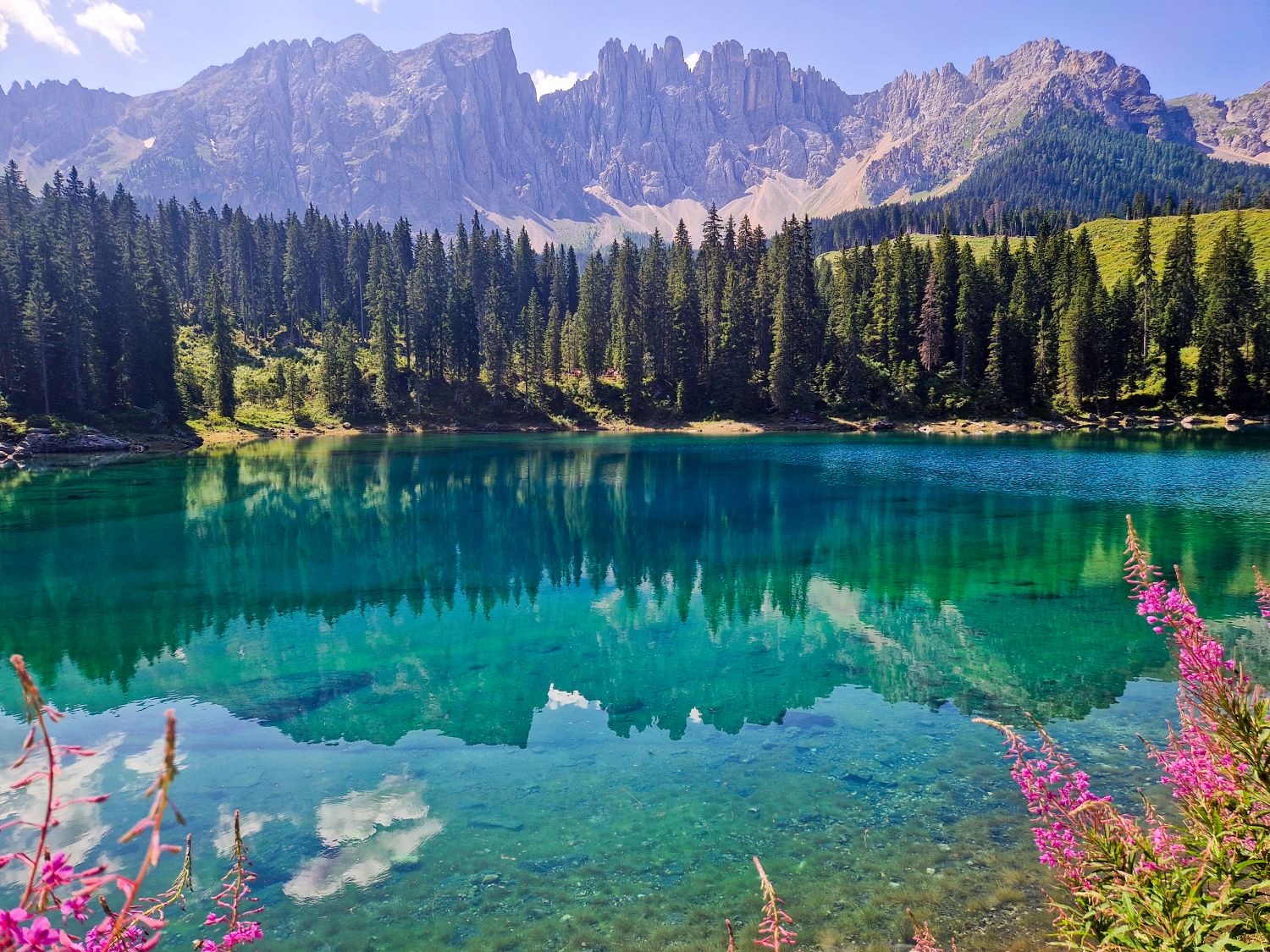
Lago di Carezza is called the Rainbow Lake – Lec de Ergobando in Ladin. The color of the water with the Latemar range reflected in it really is something, although I’d call it emerald, not rainbow.
The “rainbow” part comes from a local legend – it’s actually quite a lovely one. The best viewpoint, where you can get the picture, is a few minutes anti-clockwise from the tunnel exit – so don’t just stop at the platform.
8. Go to Alpe di Siusi – the largest high Alpine meadow in Europe

Alpe di Siusi – known as Seiser Alm in German – is the largest high-elevation Alpine meadow in Europe. It’s a very idyllic place, with rolling hills, cute little huts, and of course, the Sassolungo group in the background.
It really does look like a painting – when we visited the area for the first time one October, it was a bit cloudy, a bit hazy, and there was a tiny bit of sun on the Sassolungo. It felt like someone photoshopped the mountains (badly) on a rolling meadow.
That trip, Michal went for a quick walk on a small panoramic circuit while Emma and I went to a viewpoint and then back to the café by the gondola station. While waiting for him, we had an apfelstrudel and a cocoa, and that’s still one of my favorite Dolomites memories.
I love how versatile Alpe di Siusi are – you can have tiny walks and long hikes, or go e-biking to cover more ground. The plateau might look flat, but boy, is it hilly.
We felt it especially strongly on our winter trip – I did the Alpe di Siusi Ronda on a snowboard, and Michal went winter hiking. Both of our legs were begging for help in the evenings, haha.
Another great thing is that Alpe di Siusi is almost completely car free. There are lots of restrictions for driving up, and one of the newest is that no cars are allowed between 9AM and 5PM in the summer. The exceptions are for hotel guests and authorized vehicles.
It’s pretty amazing, especially if you’re visiting with kids – they can just run around freely.

Check when the cable car runs on the website.
9. Enjoy the best Photo spots

The Dolomites are almost like a photographer’s paradise.
There are so many beautiful places that you just basically walk around and point your camera, and that’s a nice picture right there.
So many of the areas are also really easy to reach. Like, you don’t have to hike far or drive for hours. You just take a cable car or short walk, and the spot is right there – from different lakes to different mountains.
We’ve mentioned a bunch already, such as Alpe di Siusi, lake Braies, Cadini, Tre Cime… but of course, that’s not all.
Val di Funes

Val di Funes is definitely high on the list of the most photogenic destinations in the world.
You can go to Santa Maddalena for the church view, or stop by the Ranui church, or drive towards Passo delle Erbe and just stop on the road, or go for a longer hike like Adolf Munkel – the beauty is everywhere.
It’s easy to reach the valley, and it’s also quite accessible.
Seceda

Seceda is one of the most famous views in the Dolomites, for sure. Pictures of the huge “teeth” of the Puez-Odle peaks being pushed up from the ground have been floating around Instagram for ages now.
But yes, it is worth visiting the area, and not just in summer – also in winter. You can walk around, go for harder hikes, or just enjoy a lunch with a view from the restaurant at the top.
Just make a reservation for the cable car – being famous comes with its own problems. Or you can take the cable car from Santa Cristina and hike from Col Raiser instead of riding up from Ortisei.
Cinque Torri

Cinque Torri is another one. You take the chairlift up, and you’re right there in front of the Five Towers.
You’ll also get a chance to wander through a WWI open-air museum – with the original trenches dug by the soldiers, no less.
We went through a part of them with Emma – it’s one of those rare places where the history and the good views go hand in hand.
10. Don’t miss Enrosadira (inrosadöra) – when the mountains turn pink during sunset or sunrise

Inrosadöra literally means “coloured in pink” in the Ladin language. The phenomenon, also known as Alpenglow, according to scientists, happens because of the specific mineral makeup of the Dolomite rocks. When the sun sets, it colours the mountains in different shades of red, yellow, pink, and orange. And when it rises, you get to see the peaks in colours from soft purple to bright orange.
If you’re lucky – like we were – you can see Enrosadira from your hotel room.
Or, there are tours that you can take to enjoy the Alpenglow in all its glory on different famous peaks or ranges in the Dolomites.
11. Wander through the cute little towns

The Dolomites get most of their attention for the mountains, but the towns are actually worth your attention, too. They’re small, very walkable, and the mix of Italian, Ladin, and Austrian culture gives them a very interesting feel and look.
When you’re deciding on where to stay, it’s worth also thinking about the feel of the town – you might not spend too much time there, but it can end up quite important.
Ortisei

In the west, we somehow usually end up staying in Ortisei in Val Gardena. It’s small and cute, and has amazing access to the highlights around. You can take cable cars straight up to Seceda and Alpe di Siusi from the center, so it works as a proper base for days in the mountains – but the town itself is worth your time too.
It’s cute, with a walkable center, and a nice forest just on the side. In December, Ortisei has one of the nicest Christmas markets in South Tyrol. In summer it’s walkable, lively, and has good restaurants.
San Cassiano

San Cassiano in Alta Badia is kind of a hidden gem. It’s small and very Ladin in character – and offers a different pace from the busier and more famous villages.
We went there on a trip with Emma, and also accidentally ended up spending time at the Ladin museum – we went there in search of a toilet and then couldn’t leave because the museum was so interesting.
Cortina d’Ampezzo

Cortina d’Ampezzo is the Pearl of the Dolomites, according to the locals. It’s worth a visit even if you don’t stay there. The town has a different energy from the rest of the Dolomites – it feels a bit more upscale and more Italian.
We’ve been there quite a lot of times. On our visit in April, it was quiet to the point of feeling almost empty, which was lovely and very unusual.
And in autumn the larches around Cortina turn golden orange – it was such a great introduction to the Dolomites for my parents.
12. Enjoy the food – Austrian, Italian, or Ladin

One of the most interesting things about the Dolomites is that the region has an incredible Austrian influence – especially in the South Tyrol. That means that in addition to the typical Italian pasta you get to enjoy sauerkraut and schnitzel!
The cuisine in the Dolomites is rather meat heavy so it’s not exactly a great place for vegans, although vegetarians will find quite a few options.
Some typical things that you should try are polenta (cornmeal), knodel (dumplings made with speck, cheese, or spinach), bread with fennel, and deer meat.
And you can find these things in so many places – from malga (alpine hut, sometimes called Alm or Baita) to rifugios to Michelin-starred restaurants.
13. Relax in a spa and wellness

Relaxing in a sauna or a hot tub after a long day of exploring the mountains is heavenly – let your muscles relax and just enjoy the moment. So many of the hotels in the Dolomites have spa and wellness areas that it would be a shame if you didn’t get to explore at least one of them.
And even if your hotel doesn’t have a dedicated wellness area, there are workarounds – in Ortisei, there’s the Mar Dolomit, and many hotels allow day visits to their spas. When we stayed in hotel Sureghes, it had free entrance to the Mar Dolomit included – amazing, right?
Another good reason for visiting a spa in the Dolomites? Weather.
We’re generally lucky and usually have pleasant weather during our visits, but it’s the mountains so rainy days can happen. It’s so lovely to enjoy a warm pool or relaxation room, and see how the rain is playing around in the mountains.
14. Enjoy some culture and history

The Dolomites were a WWI frontline – Italians and Austrians fought in these mountains for years. A lot of that history is still physically there if you know where to look.
Cinque Torri has a WWI open-air museum right among the rocks – reconstructed wooden trenches that you can walk through, as well as bunkers, and of course, lots of info tables.
Lagazuoi has something even more dramatic – the soldiers actually dug tunnels into the mountain itself from Passo Falzarego, and now you can hike through them. It connects directly to the cable car up to Rifugio Lagazuoi, so it works well as part of a Falzarego day.
There are many Ladin culture museums all around the Dolomites, too. The Ladin people have their own language, culture, and history that’s separate from both Italian and Austrian – and most visitors don’t even know they exist. We ended up in one by accident with Emma and found it really interesting.
And of course, the six Messner Mountain Museums, as well as a range of other are there – from photography, to art, to woodworking, and everything in between. If you like culture and history, there’s a big variety of things to look into!
15. Go up the Marmolada

Marmolada, known also as the Queen of the Dolomites, is the highest mountain and mountain range in the Dolomites. The two highest peaks are Punta Penìa (3343m) and Punta Rocca (3265m), and you can actually go all the way up on the latter with a cable car.
The main reasons to visit Marmolada?
One is the Marmolada glacier, the largest one in the Dolomites. It’s actually possible to touch the glacier by taking a lift down to it.
And another one is 360-degree panoramic view of the most popular places in the Dolomites: the Catinaccio group, the Pale di San Martino, Croda da Lago peaks of the Ampezzo Valley and Alta Badia, and so much more.
Marmolada has rock climbing and via ferrata routes for those who are more adventurous.
It’s also a historically important place, where Italians and Austrians fought during WW1. There’s a museum – Museum of the Great War in Marmolada (Marmolada Grande Guerra) which is the highest museum in Europe, located at 3000mt.
Things To Do In The Dolomites In Winter

In winter, the Dolomites transform into a paradise for those who enjoy the typical winter activities, such as skiing. But there’s so much more to do even if you don’t ski!
Of course, since the Dolomiti Superski is one of the best and biggest ski areas in the world, it’s the perfect place to hit the slopes whether you’re skiing or snowboarding.
And it’s also one of the best places to learn either of those things. On our last winter trip, I took 2 lessons with an instructor to learn to snowboard, and advanced from barely being able to going down a slope once to doing the whole Alpe di Siusi Ronda by myself without any problems. That’s how good they are.
If skiing isn’t your thing, there’s still plenty to do, as I said.
- Tobogganing – we went in Carezza, and it was SO MUCH FUN! But there are options all over – Alpe di Siusi, Tre Cime, and more. Go in the morning, though, because by the afternoon, the slopes get kind of destroyed so you’re more jumping on them than tobogganing.
- Christmas markets – in December, you will find Christmas markets in many towns. We loved the one in Ortisei, but – and this is an unpopular opinion – the Bolzano one was underwhelming.
- Snowshoeing and winter hiking – Michal went in Val Gardena and on Alpe di Siusi, and he loved it. Our next goal is going in the Eastern Dolomites – Cinque Torri, Passo Giau, and also Tre Cime. If you’re going winter hiking, make sure that you have crampons and hiking poles, though.
- Paragliding and ziplining – yes, it’s also possible in winter! The same companies run winter paragliding flights, and zipline Monte Pana also runs in winter.
And there are plenty more winter activities in the Dolomites available if that’s when you’re planning to visit.
Practical tips before your visit

Here are a few things worth knowing before you go – we learned some of these the hard way.
In short: book early, rent a car, and don’t underestimate the weather.
- Where to stay.
Val Gardena is the best overall base, especially for a first trip – it has a lot of the highlights of the Dolomites right there. For the eastern Dolomites, Cortina d’Ampezzo is the strongest alternative with great access to the major spots. If you have a week or more, split your stay between them to avoid driving for hours each day. - Book your accommodation early.
The best hotels (and best-value ones) fill up months in advance for July and August. Book yours as early as possible so you don’t have to pay double for a hotel or stay hours away from places you want to visit! - You almost certainly need a car.
The Dolomites are spread across a huge area and multiple regions, so the bus connections can get… weird. If you’re staying in one area, like Val Gardena, you can get by without driving. But if you want to explore more than one area, not having a car will limit you a lot. - Layer up.
Valley temperatures in July can hit 30°C, but the higher in altitude you go, the colder it gets. I actually wore a winter jacket at lake Braies in August! Always pack a rain layer too – afternoon thunderstorms in summer are common and they come fast. - Best timing within summer.
June means waterfalls at peak, wildflowers, and fewer crowds – but some cable cars aren’t open yet. July and August means everything is open and absolutely packed. September is the best kept secret – trails become quieter, prices get a bit lower, and the weather often still good. Make sure you match when to visit with what you want to do. - Motion sickness warning.
The mountain roads are narrow and winding so if you’re prone to motion sickness like your girl here, bring something for it and plan frequent stops. The upside? Those stops usually turn into some of the best viewpoints.
How do you choose what to do, then?

Honestly? You don’t have to do everything on this list. Nobody does everything in the Dolomites in one trip – not even us, and we’ve been there over 15 times.
Start with what excites you most. If it’s hiking, Tre Cime and Cadini are the ones to plan around first. If it’s views with minimal effort, the passes and Alpe di Siusi will do that for you. If it’s lakes, Braies and Dobbiaco are worth building a day around.
And if you want some help figuring out what actually makes sense for your specific trip, that’s what we do.
FAQs
How many days do you need for Dolomites?
As many as possible! But the minimum is 2 days (one night) – and that’s if you basically only drive through the mountains. If you’d like to include some of the best things to do, you should visit for at least 4 days. The Dolomites cover an area of more than 141ha of the Southern Limestone Alps, so that means that if you’d like to visit more than one side of them, you should spend at least a week there.
Is the Dolomites expensive?
The Dolomites are not exactly a budget destination, especially when it’s the season, but with careful planning, you can see most of the highlights for relatively cheap. When we visited in April, we stayed in an apartment, cooked most of our meals, and just did a road trip to the highlights of the Eastern Dolomites, so the trip cost around 400eur for a person for 4 days in the Dolomites.
What is the best time to go to the Dolomites?
The best times to visit the Dolomites are December to February for the winter activities and mid-June to September for hiking and summer activities.
Otherwise, things like a road trip can be done almost any time, although even for a road trip, the best time of year would be summer-ish.
Is the Dolomites good for families with kids?
Is the Dolomites good for families with kids?
Yes – and we say this as people who’ve been going to the Dolomites with our daughter Emma since she was 4. Cable cars mean even young kids can access the best views without a long hike. Most rifugios are kid-friendly, and half board hotels take the stress out of dinner after a long day.
Do I need a car in the Dolomites?
Almost always yes, you do need a car in the Dolomites. The Dolomites are spread across a huge area and bus connections between regions are limited. The exception is Val Gardena – the local bus network is good enough that you can get around without a car if you’re staying in one valley. But if you want to see both the eastern and western Dolomites, a car is pretty much essential. We have a full breakdown of getting around with and without a car if you want to think through your options.
What’s the best base for a first trip?
Val Gardena – specifically Ortisei or Selva di Val Gardena – is the best place to stay on your first trip. It gives you the best access to the western highlights, good public transport if you need it, and enough restaurants and infrastructure that you don’t have to plan every meal in advance. For the eastern Dolomites, Cortina d’Ampezzo or Dobbiaco. If you have a week or more, split your stay between both sides.
Can I visit the Dolomites without hiking?
Yes, you can easily visit the Dolomites without hiking. Mountain passes, cable cars, lakes, towns, e-biking, paragliding – a lot of what makes the Dolomites special doesn’t require hiking at all. The passes alone will give you some of the best views in the region from your car window. And cable cars will get you up to amazing views without a single uphill step.
Save this post on Pinterest


